Оновлено 11.11.2026 · Автор і рецензент: Редакція «Української Броні».
In short: the cover of a vest or plate carrier can be hand-washed in cool water with a mild detergent, but only after removing all plates and soft ballistic packages. The UHMWPE and aramid packages themselves are not washed or soaked — they are protected from moisture, UV and high temperature. A plate that has been hit, or a ceramic plate dropped onto a hard surface, is taken out of service until inspected.

The main rule: take the system apart
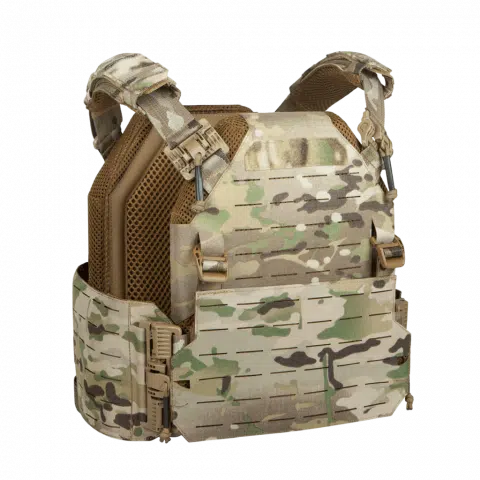
Before any cleaning, remove everything from the carrier: front and back plates, soft packages from the cummerbund and behind the plates, neck and groin modules. The cover and the ballistic elements are cared for differently, and mixing up these procedures is what most often ruins armor.
Vest and plate carrier cover
After every mission:
- shake off sand and soil, blow out the pockets and MOLLE webbing with compressed air or beat them with a brush;
- dry the carrier in the shade at room temperature with the cummerbund undone and the pockets open.
Deep cleaning (if needed):
- Remove all ballistic elements and take off the pouches.
- Soak the cover in cool or warm water (up to 30 °C) with mild soap or a delicate-fabric detergent without bleach.
- Treat stains with a soft brush in circular motions without hard rubbing: you can damage the fabric’s NIR coating.
- Rinse thoroughly so no soap remains in the fabric.
- Dry laid flat in the shade. No radiator, hair dryer, tumble dryer or direct sun.
It is better not to use a washing machine or dry cleaning: aggressive spinning deforms the rigid parts of the carrier, and solvents destroy the coating. What NIR coating is and why it is worth protecting — in the article “NIR treatment: what it is and why».
Soft ballistic packages
Soft packages are made of ultra-high-molecular-weight polyethylene (UHMWPE) or aramid. Neither material likes moisture, UV or heat, and aramid also loses properties with prolonged exposure to water and light. Therefore:
- do not wash or soak the packages, even if they are in a “waterproof” cover;
- wipe dirt off the outside with a damp cloth and dry in the shade;
- do not bend the packages sharply or store them folded — keep them flat;
- check the package cover: if it is torn and the ballistic material is exposed, the package must be replaced or inspected.
About material properties — in the article “What UHMWPE, aramid and Cordura are».
Polyethylene (UHMWPE) armor plates
Polyethylene plates are light and not afraid of water, but they are sensitive to temperature: polyethylene softens when heated, so a plate must not be left on hot metal, near a stove or on a car dashboard in the sun.
- Clean with a damp cloth and mild soap and dry.
- Do not use solvents, petrol or acetone.
- Check the surface: swelling, delaminated edges, deep cuts are a reason for inspection.
- Do not put heavy objects on the plate in storage.
Ceramic plates
Ceramic is hard but brittle. An impact on concrete or metal can create an internal crack that is not visible from outside — and the plate will lose its protective properties in that area.
- Do not drop the plate or the carrier with plates, do not stand on them or use them as a seat.
- Transport in the carrier or a separate cover.
- If a ceramic plate has fallen from a height onto a hard surface or been hit, do not use it further without inspection. Some manufacturers offer X-ray inspection.
- Clean it like a polyethylene plate: damp cloth, mild soap, drying.
Steel plates
Steel is impact-resistant but prone to corrosion. After rain wipe the plate dry and check the coating: if the anti-spall or paint coating is damaged, exposed metal rusts faster. Store in a dry place.
Helmet
- Remove the cover and pads, wipe the shell with a damp cloth.
- Velcro pads can be hand-washed in cool water and dried in the shade.
- Do not leave the helmet in the sun in a car or near heaters, and do not paint it with solvents.
- After a strong impact or hit the helmet needs inspection: damage to internal layers may be invisible.
Covers need ordinary hand care — see the section “Covers and visors”.
In the field
At a position there is no warm water or dryer, so it is important at least not to do harm:
- open up a wet carrier and dry it at the first opportunity; take out the plates and packages if their covers are made of fabric that holds moisture for long;
- do not dry armor next to a stove or on a car bonnet — this is the most common cause of damage to polyethylene plates and packages;
- knock dirt and sand out of the Velcro with a brush: clogged Velcro holds worse, and that also affects plate retention;
- at night do not leave armor on the ground — put it on a mat or hang it up.
Velcro, buckles, webbing
Hardware wears out faster than fabric. Regularly check the cummerbund buckles and the quick-release system: a crack in a buckle can fail during evacuation. Do not overload MOLLE webbing with heavy pouches on one row. Clean threads and dirt out of the Velcro. If hardware breaks, contact the store — some parts can be replaced.
After a hit
Any plate or package hit by a bullet or a large fragment has done its job and no longer guarantees the stated class in that area. Do not try to “patch” the armor. Photograph the damage, remove the element and replace it. If you are not sure whether there was a hit, show the product to specialists.
Storage and transport
- A dry room at room temperature, out of direct sun.
- Plates — flat (horizontally or vertically in a rack), with no load on top.
- Carrier — laid out or on a wide hanger so the shoulders do not deform.
- To transport several kits — a separate cover or bag so the plates do not knock against each other.
Service life
The service life of ballistic materials is set by the manufacturer of the specific product. Composite materials gradually lose properties over time, especially if stored in sun, humidity or heat. So keep your armor documents, monitor the condition of covers and plates, and do not buy used armor without a history and test report.
Quick checklist
- After a mission: shake out, dry in the shade.
- Wash the cover only without plates and packages, by hand, up to 30 °C.
- Packages and plates — do not wet, do not heat, do not leave in the sun.
- Ceramic plates — do not drop; after a fall or hit — inspection.
- Store flat, dry, with no load.
Frequently asked questions
Can a plate carrier be machine-washed?
Better not: spinning and the drum deform the rigid parts of the carrier and damage the coating. Hand-wash the cover in warm water up to 30 °C with a mild detergent after removing all plates and packages.
Can soft ballistic packages get wet?
No. UHMWPE and aramid are protected from moisture, UV and heat; packages are only wiped on the outside with a damp cloth and dried in the shade.
What should I do with a plate after a hit?
Remove it, photograph the damage and replace it. A plate that has been hit does not guarantee the stated class in that area.
Is a polyethylene plate afraid of heat?
Yes, polyethylene softens when heated: do not leave the plate on hot metal, near a stove or in the sun in a car.
How can I tell that a ceramic plate is damaged?
A crack is often not visible from outside. If the plate has fallen onto a hard surface or been hit, do not use it without inspection by specialists.
Where to buy. You can try on and buy in our stores in Kyiv, Kharkiv and Dnipro (daily 10:00–19:00) or online with Nova Poshta delivery across Ukraine.
Sources
- Recommendations on Ukrainian Armor product pages; ballistic material manufacturers’ instructions (general storage requirements for UHMWPE and aramid)