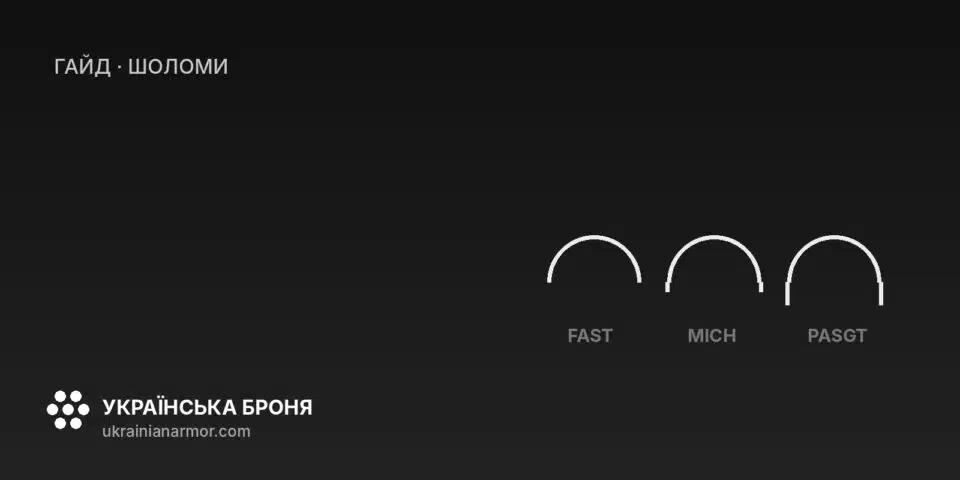
A ballistic helmet is designed primarily for fragments — they cause most head wounds. All helmets in our catalog are class 1 under DSTU 8782:2018: they also stop 9×18 and 9×19 mm handgun bullets. FAST, MICH and PASGT differ in shell shape, coverage and compatibility with gear.
Comparison of cuts
| FAST | MICH | PASGT | |
|---|---|---|---|
| Cut above the ears | high | medium / low | none, ears covered |
| Protected area | smallest | medium | largest |
| Active headsets | over the helmet, on rails | under the helmet or earplugs | inconvenient |
| Rails, NVG mount | є | є | none |
| Who for | assault, SOF, drone operators | universal | checkpoints, medics, journalists, deminers |
FAST — for headsets and mounted equipment
FAST (Future Assault Shell Technology) has high side cuts: active headsets sit over it without pressing on the ears, and a headset, light or camera mount on the side rails. The front mount takes a night vision device; Velcro holds IDs and markers. The trade-off is less coverage of the temples and ears.
Models: FAST “Ustrash” 1.0 (aramid, M–XL), “Ustrash” 2.0 (L–XL), “Ustrash” 3.0 with an aluminum front mount insert. FAST is compatible with EarMor headsets with ARC mounts — M31X, M32X.
MICH — a compromise between coverage and compatibility
MICH (Modular Integrated Communications Helmet) partly covers the ears, so coverage is larger than FAST. Headsets are worn under the helmet, or active earplugs are used. It has an NVG shroud, side rails and Velcro.
Models: MICH “Buitur” 1.0 and “Buitur” 2.0 made of aramid (Kevlar®). The generations differ in suspension: 1.0 has a BOA / Team Wendy-type dial adjustable with one hand; 2.0 has an Ops-Core-type frame system that holds the helmet on the head even with mounted equipment. More — in the article “Differences between “Buitur” 1.0 and 2.0».
PASGT — maximum coverage
PASGT (Personnel Armor System for Ground Troops) is the classic shell covering the back of the head, temples and ears. It has no rails or NVG mounts, and headsets are uncomfortable. But it offers the largest coverage — which is why PASGT is chosen for checkpoints, security, medics, journalists and humanitarian demining.
Models: PASGT “Dzhura” UHMWPE (sizes M–L) and aramid “Dzhura”. For PASGT there are camouflage covers and visors.
Where these cuts came from
PASGT appeared in the US Army in the 1980s to replace the steel M1 helmet — the first mass-issued aramid fiber helmet. In the early 2000s MICH was developed from it for special operations forces: the brim and part above the ears were cut away to fit headsets. FAST was the next step — an even higher cut and a rail system for mounted equipment. So each cut is a compromise between coverage and gear compatibility, and the right choice depends on what you wear with the helmet.
Weight and the neck
A helmet is the part of your kit furthest from your center of gravity, so every 100 grams on the head loads the neck more than a kilogram on the belt. Add NVGs, a light and headset — and it becomes clear why helmet weight is worth comparing carefully. If you work with mounted equipment for long periods, choose a lighter shell and balance the equipment with a counterweight at the back.
Aramid or UHMWPE
Aramid (Kevlar®) — a synthetic fiber with high heat resistance: it does not melt and keeps its properties when heated. UHMWPE (ultra-high-molecular-weight polyethylene) — lighter and resistant to moisture and UV, but more sensitive to high temperatures. Both materials give the same DSTU class 1 in our helmets — compare weight, cut and price of the specific model. More about materials in the article “About ballistic materials».
Suspension and pads
The suspension determines how the helmet sits and whether it slides. A BOA / Team Wendy-type dial adjusts with one hand right on the head — handy when different people wear the helmet or with a winter hat. An Ops-Core-type system with a rigid frame holds the helmet better with heavy mounted equipment. Pads provide comfort and partly absorb impact: they can be repositioned so the helmet sits level without pressure points. Before going out, check that the chin strap is tight and the helmet does not shift when you turn your head sharply.
Which helmet for whom
- Assault, SOF — FAST: headsets over the helmet, NVG, light, camera.
- Drone operator — FAST or MICH: headsets and comms, minimal weight.
- Infantry in positions — MICH: more temple protection, works with earplugs.
- Medic, evacuation crew — MICH or PASGT, depending on comms needs.
- Journalist, volunteer, security — PASGT: maximum coverage without mounted equipment.
- Deminer — PASGT з with a fragmentation visor.
Helmet and comms
If you work with a radio, plan the helmet together with the headset. For FAST — headsets mounted on ARC rails (EarMor M31X — single channel, M32X — dual channel). For MICH — headband headsets under the helmet or M20T Pro active earplugs. Always try them on together: the headset must not lift the shell.
Why not class 2
Higher-class helmets exist but are significantly heavier and more expensive. Extra hundreds of grams on the head are felt in the neck within hours, and the main threat to the head is fragments, against which class 1 with a good V50 works effectively. That is why armies around the world mostly use helmets of this level.
How to choose the size
- Measure your head circumference with a tape 1–2 cm above the eyebrows, around the widest part of the back of the head.
- Compare it with the size chart on the model page. As a guide from our size chart: M — 53–56 cm, L — 56–59 cm, XL — 60–63 cm.
- Put the helmet on: the front edge 1–2 fingers above the eyebrows, and the shell should not wobble when you tilt your head.
- Adjust the suspension and pads; check the balance with headsets and NVG.
Step by step about sizes — in the article “How to determine the size of a military helmet”. Best of all — try it on in a store: stores in Kyiv, Kharkiv and Dnipro.
Mounted equipment
If you plan to work with a night vision device, thermal sight, light or camera, the choice essentially comes down to FAST or MICH with a front mount and side rails. NVGs shift the center of gravity forward — to keep the helmet from sliding over your eyes you need a stable suspension (like the Ops-Core type on “Buitur” 2.0) and, if needed, a counterweight at the back. For camouflage use a cover matching the helmet cut: it also protects the shell finish.
Common mistakes
- Buying a helmet “to grow into”: an oversized shell wobbles and slides under the weight of equipment.
- Choosing PASGT for active headsets — they will not fit over the covered “ears”.
- Wearing a helmet without the chin strap fastened — in a blast or fall the helmet flies off.
- Not checking compatibility with glasses: the temples must not press into the pads.
Models in the catalog
| Model | Shape | Material | Sizes |
|---|---|---|---|
| Ustrash 1.0 | FAST | aramid | M–XL |
| Ustrash 2.0 | FAST | aramid | L–XL |
| Ustrash 3.0 | FAST | aramid | see product page |
| Buitur 1.0 | MICH | aramid | M–XL |
| Buitur 2.0 | MICH | aramid | L–XL |
| Dzhura | PASGT | UHMWPE | M–L |
All models are class 1 under DSTU 8782:2018. Check available colors and sizes on the product page.
Care and replacement
After a direct hit a helmet may lose its ballistic properties — it should be replaced even if not penetrated. Keep the helmet away from direct sun and heaters, and wash only with a mild soap solution.
All models — in the section “Helmets”.
Frequently asked questions
Which helmet is the lightest?
Usually FAST — thanks to the cuts; compare the exact weight on the pages of specific models and sizes.
Does a helmet protect against rifle bullets?
No. DSTU class 1 is designed for fragments and 9×18 and 9×19 mm handgun bullets.
What to choose for active headsets?
FAST: headsets mount over the helmet on ARC rails. With MICH, headsets are worn under the helmet or active earplugs are used.
Should a helmet be replaced after a hit?
Yes, after a direct hit the ballistic properties may deteriorate, so replacing the helmet is recommended.
Can I wear a helmet with glasses?
Yes. Choose ballistic glasses with thin temples and check at the fitting that they do not press into the pads and headset.
Which helmet for drills and training?
The same one you use on duty: you need to get used to the real weight and fit. On a limited budget, start with MICH as the most versatile cut.
Where to buy. You can try on and buy in our stores in Kyiv, Kharkiv and Dnipro (daily 10:00–19:00) or online. Nova Poshta delivery across Ukraine; consultation — +380 99 801 75 15.